
Partial lunar eclipse on 28 August 2026: Copper Moon at dawn
It’s just before six in the morning. The sky in the west is already turning pink, and an eclipsed moon hangs above the horizon. Next to it, a narrow, bright rim glows. And behind me, the first birds are beginning to sing.
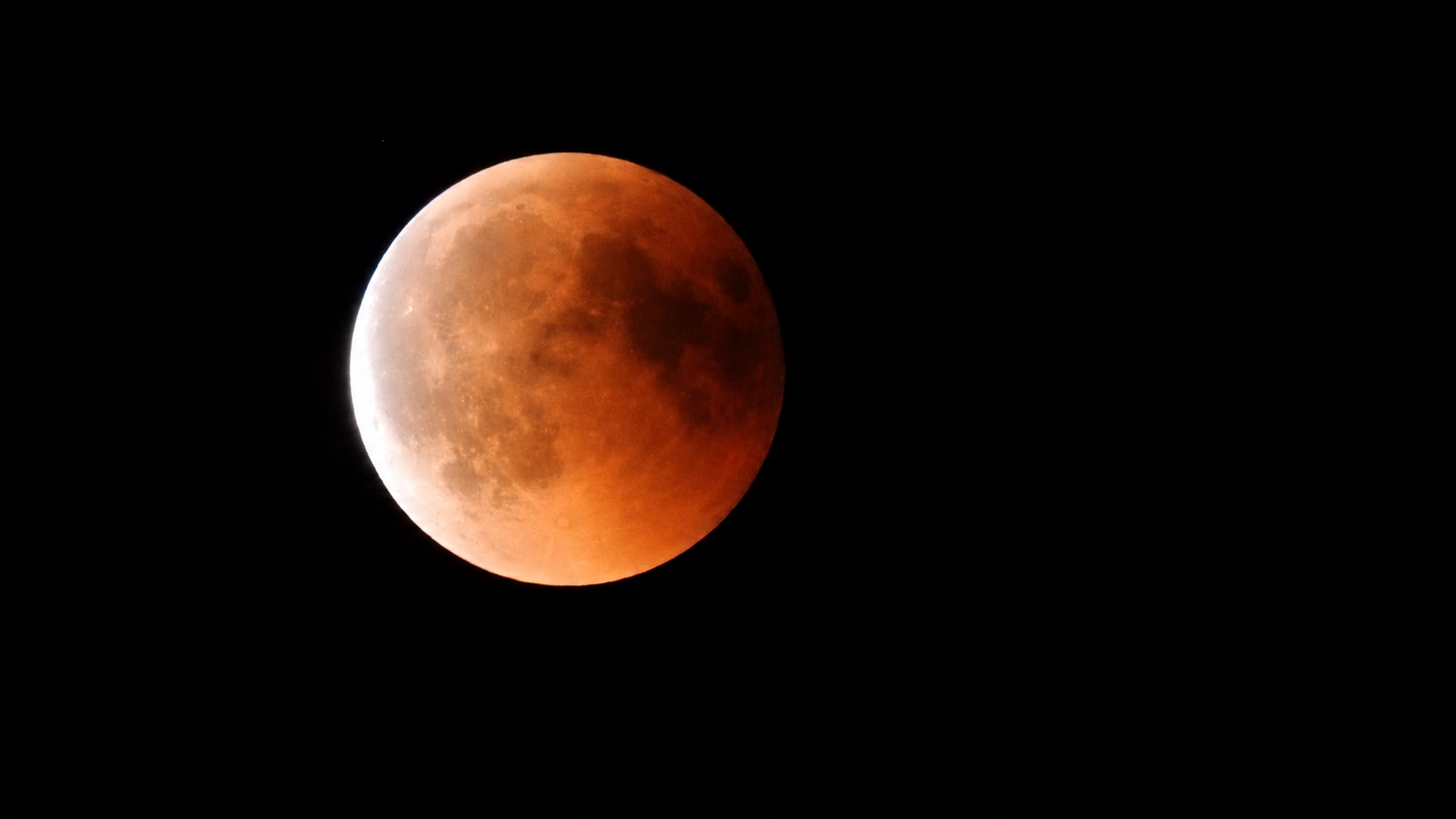 Image: The total lunar eclipse of 27 July 2018 as the Moon emerged from the umbra
Shortly after the solar eclipse, August brings another highlight: a partial lunar eclipse in the morning. Well, the sky certainly has plenty to offer at the moment. But first thing in the morning, of all times?
Unfortunately, the universe doesn’t ask anyone beforehand. So it’s best to get a good night’s sleep, then have a delicious coffee for that morning boost and head out into nature. Because early on Friday morning – 28 August – the full moon will be almost completely immersed in the Earth’s shadow. With a coverage of 96.2 per cent, it’s an exceptionally deep partial lunar eclipse. Only a few per cent of the Moon’s diameter will escape the umbra. Unlike a solar eclipse, you can enjoy a lunar eclipse completely without protective glasses and without any risk.
The lunar eclipse on 28 August 2026 at a glance:
- Entry into penumbra: 2.23 am CEST, visible at most as a faint grey haze
- Start of the partial phase: 3.33 am CEST
- Maximum: 5.12 CEST with 96.2 per cent coverage
- Moonrise: between 6.12 and 6.47 CEST, depending on location
- Viewing direction: West, unobstructed horizon
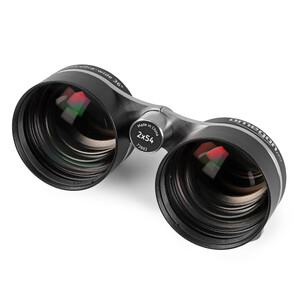
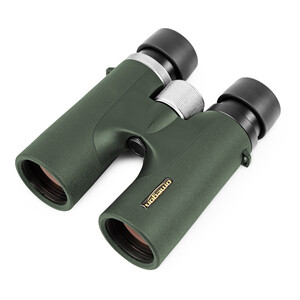
- Equipment: the naked eye is sufficient; binoculars or a telescope provide a better view
An almost perfect copper moon
But let’s get back to the basics: what’s actually happening there?
During a lunar eclipse, the Sun, Earth and Moon are almost in a straight line. The Earth is then positioned exactly between the Sun and the Moon. However, this does not happen during every full moon, but only when the Moon is near one of the nodes of its orbit. This is where the Moon’s orbit intersects the plane of the Earth’s orbit.
The Earth then casts a shadow that extends over a million kilometres into space, but tapers to a cone shape as it progresses. At the Moon’s distance, the Earth’s shadow is about 9,200 kilometres wide. So, theoretically, the Moon could fit inside it several times over.
However, the Moon and the centre of the shadow do end up missing each other by a tiny bit. On 28 August 2026, our satellite will not strike the Earth’s shadow quite at its centre: a narrow edge will escape. At the peak of the eclipse, a bright crescent will remain. The eclipsed part will not simply turn black, but will glow with a copper-red hue. Whether you notice this will depend on the conditions. The colour is more clearly visible through binoculars and in photographs than to the naked eye.
A race against dusk
In Europe, the lunar eclipse will take place in the second half of the night and – as mentioned – during dawn. Because the full moon and the sun are directly opposite each other, the moon sets in the west at exactly the same time as the sun rises in the east. That’s why it’s important to find a spot with an unobstructed view of the western horizon to watch the lunar eclipse.
Right, now for a few figures: the partial phase of the lunar eclipse begins in London at 3.33 am CEST. That’s when the Earth’s dark umbra will first become visible as it passes over the full moon. A good hour before that, from 2.23 am, the moon will already be moving through the penumbra. All you’ll see of this is, at most, a faint grey haze. Maximum coverage will then occur at around 5.12 am CEST. At that point, around 96 % of the Moon’s surface will be covered by the umbra. It’s a real race against twilight. Spoiler: twilight wins. Sorry, I didn’t mean to give the ending away, but I thought you should know what you’re in for.
Because whilst the moon sinks lower and lower in the west, the sun rises in the east. It rises in London at around 6.06 am. All of this is, of course, accompanied by birdsong. Exactly when the moon sets, however, depends on where you are.
Find the right place
Find yourself a nice spot with a view towards the west. Even a single tree or a house roof can obstruct the view when the object is just a few degrees above the horizon. So choose your vantage point wisely. A slightly elevated spot is also helpful. You can observe it with the naked eye. But here’s a personal tip: you’ll see the details much better through binoculars or a telescope.
Capturing the lunar eclipse on camera
 This diagram is intended to illustrate how large the Moon appears in the photograph.
A copper-coloured moon over the twilight landscape: it’s a scene you rarely get to capture through your lens. One challenge is the difference in brightness between the glowing crescent and the darker shadowed areas of the moon. In the very early stages of the lunar eclipse, when the moon is still higher in the sky, it’s worth taking detailed shots using a longer focal length or a telescope. Later, as twilight sets in, the landscape in the frame becomes more interesting. Perhaps with the silhouette of a nearby tree? That makes for a striking image.
What camera settings do you need?
- Focus: manual
- File format: RAW
- Bright residual crescent: ISO 100 to 200, aperture f/8, approximately 1/125 of a second
- Eclipsed region: ISO 800 to 1600 and an exposure time of several seconds
- Remote shutter release or self-timer
- Depending on the focal length: camera on a tripod, camera on a travel mount or telescope
With wide-angle lenses or focal lengths of up to around 200 mm, you can capture the moon alongside the landscape. This is particularly useful when the moon is relatively close to the horizon. The diagram shows how large the moon’s disc appears on your sensor. Pay particular attention to the millimetre figures for the diameter: at 200 mm, it measures just 1.7 millimetres on a full-frame sensor. The moon only becomes significantly larger from around 1,000 mm. It’s best to take exposure bracketing shots of each phase.
When only a small sliver of the moon’s edge is visible, take both a short-exposure shot and a long-exposure shot to reveal the dark areas of the moon’s surface features.
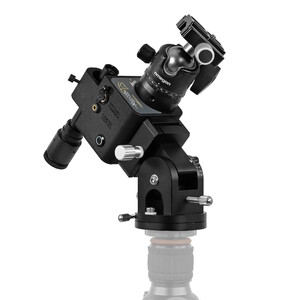
If you’re working with telephoto lenses, the Omegon MiniTrack or the Segugio Tracker will come in handy. These two travel mounts track your camera precisely, ensuring you get sharp, perfectly tracked photos of the Moon.
And that was it for the eclipses this year. Because the solar eclipse on 12 August and the lunar eclipse on 28 August go hand in hand.
I hope you enjoy the shadow play and have a great start to the day.
.jpg)

Author: Marcus Schenk
Marcus is a stargazer, content creator and book author. He has been helping people to find the right telescope since 2006, nowadays through his writing and his videos. His book "Mein Weg zu den Sternen für dummies Junior" advises young people, and those who are still young at heart, what they can discover in the sky.
As a coffee junkie, he would love to have his high-end espresso machine by his side under the starry sky.