Wide range of innovative products
In-house development & manufacturing

Author Archives


Marcus Schenk

Marcus Schenk

Posts composed by Marcus Schenk

Infographic: Astronomy Highlights Winter 2025/26

November 27 2025, Marcus Schenk

The winter draws near and with it the darkest time of the year. Already in the early evening the Winter Hexagon sparkles in the sky and invites you to observe. In the coming three months there is much to discover in the heavens: from the Geminids without disturbing moon‑light to the bright Jupiter and even a small planetary parade in February. Our new astro‑highlights guide you through this time: month by month, star by star.

If you like, you are welcome to embed the graphic on your own website. Please link it then to www.astroshop.eu

December

4 Dec. Moon meets the Pleiades
In the early morning hours the nearly full Moon passes through the constellation Taurus and encounters the Pleiades, one of the most beautiful open star clusters of the winter sky. In binoculars the close encounter appears particularly impressive. Even with the bare eye you recognize the group as a small, sparkling star‑nest next to the Moon. Around 4 a.m. the constellation stands high in the sky and offers a mood‑filled start to the winter observations.

7 Dec. Mercury at greatest western elongation
Shortly before sunrise the otherwise shy Mercury shows itself. At the beginning of December it reaches its greatest western elongation, i.e., the largest separation from the Sun, and thus stands particularly favorably in the morning sky. From about 6:30 a.m. you spot it deep above the south‑eastern horizon, as a small, bright point in the first light of dawn. A clear horizon view is essential, because the time window is short before the Sun outshines it. For early risers the view pays off: Mercury appears as distinctly as hardly any other time of the year.

14 Dec. Maximum of the Geminids
On the night from 13 to 14 December you have, with a bit of weather luck, the chance to admire the most famous winter meteors. This active meteor stream reaches its maximum, and the conditions this year are almost perfect: the Moon hardly disturbs, the sky remains deep dark for most of the time. From midnight the radiant rises high in the sky, and the activity increases once again. Under good conditions you could theoretically count up to 80 meteors per hour. In practice there will be fewer, yet every bright meteor is a moment, right?

21 Dec. Start of winter
Here it is: Winter begins, and at 16:00 the Sun descends as deeply as it never does all year. The day bids farewell early and the night stretches across the remaining hours. For many stargazers this is the finest time of the year: Long nights invite you to set up the telescope after work. From now on the light also returns slowly – barely noticeable, yet a little more each day.

22 Dec. Ursids
Hardly are the Geminids over, the next meteor stream is already on deck. On the night from 22 to 23 December the Ursids reach their maximum. This is a small but fine meteor stream, appearing to come from the constellation Ursa Minor. With about ten meteors per hour it offers no spectacle, but rather a modest finale. In this year no moonlight disturbs, and in the long winter nights you can take your time.

31 Dec. Moon meets the Pleiades
Late in the afternoon dusk sets in, and you discover the bright Moon exactly above the eastern horizon. If the sky is clear, the two bright stars Aldebaran and Capella appear close by. Next to the Moon, at about 1.5 degrees distance, you recognise the Pleiades. In comparison to the Moon they appear almost delicate. By the way: If you raise a glass at midnight, above you shines the bright Jupiter, which reaches opposition in January.


January

3 Jan. Quadrantids
Hardly has the new year begun, meteors again streak across the sky. On the night from 3 to 4 January the Quadrantids reach their maximum. Their radiant lies in the modest constellation Boötes, near the star Arcturus, and only rises higher after midnight.

3 Jan. Moon meets Jupiter
Right after the meteor shower another spectacle shows: On the night from 3 to 4 January the Moon passes near the planet Jupiter. Around 10 p.m. the two celestial bodies stand about three degrees apart. You notice that with the bare eye.

6 Jan. Moon meets Regulus
Late in the evening the waning Moon traverses the constellation Leo and encounters Regulus, the constellation’s brightest star. A star‑occultation by the Moon even takes place, which you cannot follow because Regulus still lies below the horizon at that moment. In binoculars the two bodies later appear splendidly.

10 Jan. Jupiter at opposition
Today Jupiter stands in opposition to the Sun. Now it lies closest to Earth and is visible all night long. Once the Sun sets, Jupiter ascends in the east and reaches its highest point in the south around midnight. With a brightness of about −2.7 mag it outshines every constellation and dominates the winter sky. Even in binoculars you recognise its four Galilean moons as tiny points of light shifting night by night. In a telescope you see its cloud‑covered atmosphere with its typical belts – and perhaps the “Great Red Spot” if it happens to be visible.

23 Jan. Moon meets Saturn
In the early evening the crescent Moon passes by Saturn – a beautiful sight during dusk. Around 6 p.m. the two stand in the southwest, about five degrees apart. The ring planet shines as a yellowish point, while the Moon hovers directly above. With binoculars you see both comfortably in the same field of view, and in a telescope the fine rings of Saturn already show at modest magnification. For many this is the last good chance to observe the planet before it sinks deeper into the dusk in February.

27 Jan. Moon meets the Pleiades
On this night the Moon again passes the Pleiades and comes especially close to the cluster. Around 10 p.m. both stand in the constellation Taurus, only a few arc‑minutes apart. At about 10:35 CET the Moon even occults the 4.3 mag bright star 19 Tau with its dark side. Tip: Times and whether an occultation occurs depend on location in Europe. Even with the bare eye you easily notice the Moon–Pleiades approach if the sky is clear. A familiar sight for many amateur astronomers – yet still fascinating.

30 Jan. Moon meets Jupiter
At month’s end two of the most noticeable objects in the sky meet: the bright Moon and Jupiter. Late in the evening they stand together in the constellation Gemini and catch the eye effortlessly. Not far away the stars Castor and Pollux glitter and frame the scene.


February

3 Feb. Moon meets Regulus
On this evening the Moon again traverses the constellation Leo and passes Regulus at exceptionally close distance. Only at about 5 a.m. the closest approach at approximately ten arc‑minutes occurs. That is extremely close and thus definitely worth looking.

7 Feb. Moon meets Spica
In the second half of the night (i.e., the night of 6/7 February) the waning Moon meets the bright main star of the constellation Virgo: Spica. Shortly before sunrise both stand deep above the south‑eastern horizon, only somewhat more than two degrees apart.

11 Feb. Moon meets Antares
Before dawn the Moon crosses the constellation Scorpius and approaches the reddish glowing Antares. Around four a.m. both appear above the south‑eastern horizon. Antares – a red super‑giant and the heart of the Scorpion.

18 Feb. Moon meets Mercury and Venus
On 18 February the Moon approaches the two planets Mercury and Venus, which stand in the evening dusk directly above the western horizon. This evening proves special, because the already delicate young lunar crescent is only 1.5 % illuminated, for the new Moon occurred just yesterday. That creates a beautiful mood‑portrait.

19 Feb. Moon meets Mercury and Saturn
A lovely trio shows up in the early evening deep above the western horizon. The young Moon stands in the dusk snugly between Mercury and Saturn. Both planets remain hard to catch, because the dusk dominates. Yet if you start observing early you also discover Venus right over the horizon.

27 Feb. Moon meets Jupiter
Toward month’s end the Moon and Jupiter meet again, this time high in the constellation Gemini. Already in the early evening both are unmistakable: the two brightest objects of the sky close together.

28 Feb. Small planetary parade
As a finale you face a rare spectacle. Shortly after sunset several planets line up along the ecliptic. Mercury and Venus very low in the west, a little higher Saturn and invisible beside it Neptune. High in Gemini shines Jupiter and in Taurus the faint Uranus. You see: everything present here, yet the parade demands effort: Some planets stand low and fade quickly in the dusk. If you bring patience and pick a spot with perfect horizon view, then you may discover several planets with binoculars.

More aperture, same price: 10″ Dobson promotion

October 1 2025, Marcus Schenk

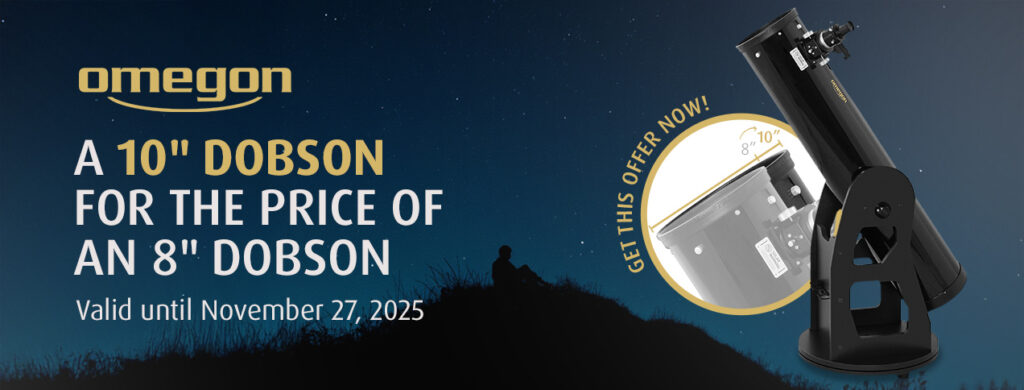
Only from October 1 to November 27, 2025: Now you can get the Omegon Advanced Dobson N 254/1250 at the price of the smaller 8-inch model.
That means: More aperture, more light and more deep sky. With a 254 mm mirror, you can see faint galaxies, nebulae and star clusters much better. The telescope is easy to use and ideal for anyone who simply wants to see more.

Secure this great offer now – only while stocks last.

SALE: Special prices in autumn!

September 30 2025, Marcus Schenk


The leaves and prices are falling this autumn!

You can find our colorful selection of special offers here in the shop. Get them now!

The offer is valid from September 30rd to November 23th, 2025 and only while supplies last!

Infographic: Astro Highlights in Autumn 2025

August 29 2025, Marcus Schenk

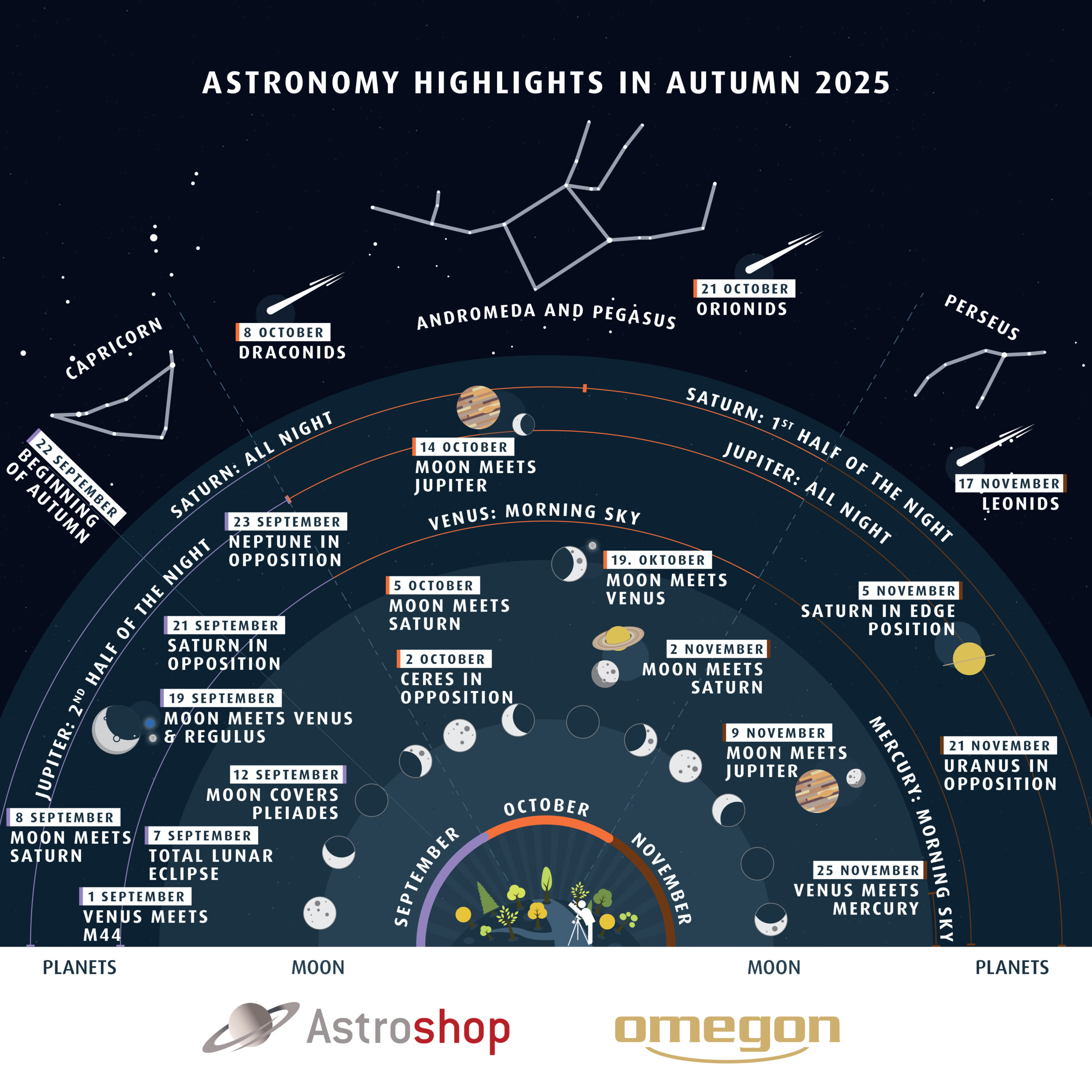
The nights are getting longer and the air is often clear: a good time to observe the sky. In autumn 2025, there will be special celestial events. Experience a total lunar eclipse, rare planetary conjunctions, or an occultation of the Pleiades.In the current infographic “Astro Highlights in Autumn 2025,” we have clearly compiled the most beautiful celestial events.Feel free to use the graphic on your website (with a link to www.astroshop.eu) and inform your visitors about the exciting upcoming events.

1.9. Venus meets the star cluster M44

On the morning of September 1, it is worth a look at the eastern sky: Venus is very close to the open star cluster M44, also known as Praesepe or the Beehive. The sight is already recognizable to the naked eye as a faint light spot right next to the prominent Venus. With binoculars, the stars of the cluster become clearly visible.

7.9. Total Lunar Eclipse

On the evening of September 7, a real highlight awaits you: a total lunar eclipse. For Central Europe, the timing is particularly favorable, as the moon rises already eclipsed. This means you will see the moon directly on the eastern horizon in the evening.

Times for Germany:

The eclipse begins even before moonrise, which occurs in Germany around 7:38 PM, depending on the location. At this point, the moon is in the midst of totality and appears noticeably reddish. It reaches maximum darkness around 7:30 PM, and the total phase ends at 8:53 PM.

For an unobstructed view, you should find a spot with a clear view to the east. Binoculars will show the lunar eclipse beautifully, but a telescope with a smartphone adapter is also great equipment for quickly capturing a photo.

8.9. Moon Meets Saturn

On the night of September 8th to 9th, the nearly full moon is near Saturn. Both objects are easy to find in the sky with the naked eye: the bright moon as a distinctive point and Saturn a little further away as a “star” that shines steadily.

This duo can be observed particularly beautifully through binoculars. You can recognize the planet as a small, yellowish disc – its rings appear as a thickening at low magnification. For many, this is a good opportunity to take out the telescope and examine the rings more clearly.

12.9. Moon covers Pleiades

On this night, our satellite covers the Seven Sisters, including all the bright main stars of the star cluster. It begins around 10 PM: The moon approaches from the eastern direction and first covers the star Electra. Then it continues to move – from its bright side – in front of the remaining companion stars. It’s best to observe all of this from an unobstructed location with a good horizon view. In addition to the interesting and quite rare occultation, it is the first harbinger of the winter sky, as the Pleiades officially belong to the constellation Taurus.

19.9. Venus meets Regulus

On the morning of September 19, it’s worth taking a look at the dawn sky. Venus is still the morning star and on this day is very close to the bright star Regulus in the constellation Leo. Nearby, you can also see the delicate crescent moon. Together, they create a beautiful trio in the sky.

If you are an early riser, this is your opportunity to capture the moment with your camera.

21.9. Saturn in Opposition

On September 21, Saturn is in opposition to the Sun. This means: Earth is positioned directly between the Sun and Saturn, and the ringed planet is visible all night long, reaching its greatest brightness. The special feature of the 2025 opposition: The rings are almost seen edge-on, making them hard to see and only about 2 degrees open. Even during twilight, the ringed planet rises above the eastern horizon and follows its apparent arc across the sky until dawn.

23.9. Neptune in Opposition

On September 23, Neptune reaches its opposition and stands favorably in the sky. This distant ice giant can be seen all night and appears in the telescope as a small, bluish disk.

Neptune is about magnitude 7.8, making it invisible to the naked eye. Binoculars show it as a faint point of light, but a telescope is needed for reliable identification. A star chart or app can help locate it in the constellation Aquarius.

2.10. Ceres in Opposition

On October 2, the dwarf planet Ceres reaches its opposition to the Sun. It is visible throughout the night and is particularly close to Earth. Ceres, with a brightness of 7.6 magnitude, can easily be found with binoculars or a small telescope. Ceres moves as an inconspicuous point of light through the constellation Cetus, but it is not visible to the naked eye. However, a simple pair of binoculars separates it from the fainter stars in its vicinity. Those who track its movement from night to night will recognize the typical motion of a planet against the backdrop of fixed stars.

5.10. Moon meets Saturn

On the evening of October 5th, the almost full moon passes by the ringed planet Saturn. Both are high in the sky and easily found with the naked eye. In a telescope, Saturn appears as a yellowish glowing disc. The narrow edge of the rings is only visible with a small aperture. Although the bright moon brightens the sky, it doesn’t matter for observing Saturn.

8.10. Draconids

The Draconids are a rather unknown meteor shower and reach their peak every year at the beginning of October. The name already reveals it: The meteors seem to come from the constellation Draco. This constellation is visible in the sky all night. The number of meteors varies greatly and always brings surprises. Normally, about ten meteors fall per hour, but in 2012, there were suddenly 400. What does that mean? It’s always worth taking a look at the sky, because perhaps a surprise is waiting. However, this year the moon will cause a brighter sky.

14.10. Moon meets Jupiter

In the second half of the night from October 13 to 14, the waning half moon meets the giant planet Jupiter. Both are in the constellation Gemini and are already conspicuous to the naked eye. You will see the moon as a bright half-circle and Jupiter as a shining point of light beside it.

19.10. Moon meets Venus

Early in the morning on October 19, the thin crescent moon is close to the bright Venus. Both can be seen well in the eastern sky. Together, they create a beautiful photographic motif.

22.10. Orionids

Meteor showers are a beautiful event for any enthusiastic stargazer, and the Orionids are no exception. Peaking from October 21 to 22, they promise about 25 to 30 meteors per hour. However, the number of shooting stars can vary from year to year. To catch the best view, set your alarm and look outside in the early morning hours. A must for all shooting star lovers.

2.11. Moon meets Saturn

On the evening of November 2, the Moon is near the planet Saturn. Both shine in the southeastern horizon already at dusk. The Moon is a prominent point of orientation, and Saturn is slightly to the west of it.

November: Saturn in Edge Position

In November 2025, Saturn’s rings will still be in edge position as seen from Earth. They will appear so narrow that they are hardly visible. This is a unique opportunity to observe Saturn without its ring system, even though the sight will be very unusual. Additionally, there will be two Titan transits in November. On November 6 and November 22, the moon Titan will pass across the gas giant.

9.11. Moon Meets Jupiter

On the night of November 9 to 10, the Moon moves past the planet Jupiter. The Moon appears as a large bright spot, and Jupiter looks like a very bright star.

A pair of binoculars or a telescope reveals even more details. On Jupiter, you can see two dark bands of clouds. Next to it are its four largest moons, arranged as small bright spots evenly spaced. The Moon also shows many craters, which are particularly visible along the terminator.

17.11. Leonid Meteor Shower

On the night of November 16 to 17, the Leonids reach their maximum, offering an impressive celestial event with up to 20 meteors per hour. This celestial event is a must for meteor fans.

The Leonids get their name from the constellation Leo, from which they appear to originate. The origin of this meteor shower lies in the comet Tempel-Tuttle, whose particles cause the meteor showers annually. Particularly noteworthy: every 33 years, the meteor stream condenses into a real meteor shower, producing far more than 20 meteors per hour – sometimes even up to several hundred per hour.

21.11. Uranus in Opposition

Uranus reaches its opposition. It shines with a brightness of 5.6 mag. Theoretically, you can see Uranus with the naked eye. In practice, however, it is better to use binoculars or a telescope. This way, you can clearly identify it.

To find Uranus, it is best to use a star map. Through a telescope, Uranus appears as a small, clear disc. It has a slightly greenish color.

25.11. Venus meets Mercury

On the morning of November 25th, Venus and Mercury will be close together at the southeast horizon. Both planets will be visible shortly before sunrise. Venus shines much brighter and thus helps with orientation. The observation is not easy, as it takes place very close to the horizon during dawn.


The Sky in Ultra Wide Angle: special prices on Omegon 100° Eyepieces

August 1 2025, Marcus Schenk

Experience the vastness of the sky with the Omegon Panorama II Eyepiece Series. Now at a special price!

With a huge 100° field of view, these eyepieces offer an observation experience that feels almost limitless. From 21 mm (2″) to 5 mm (1.25″) focal length, the four models are perfect for deep-sky objects, wide star fields, but also for more compact objects like planets.

Get yours now. Offer valid until 30/09/2025 and only while stocks last!

Galactically cheap: 30% off Omegon Blackstar binoculars

August 1 2025, Marcus Schenk

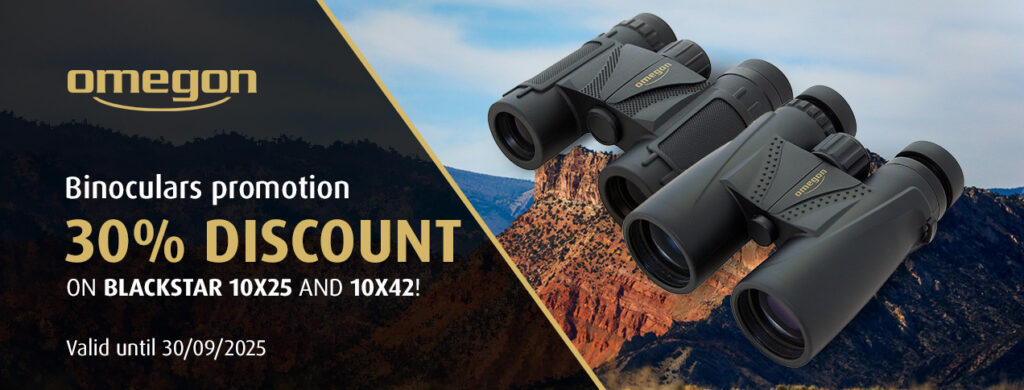
Time to keep your eyes open again! With our summer promotion, you save a whopping 30% on the popular Omegon Blackstar binoculars 10×25 and 10×42 – only until September 30.

Whether you are out walking, traveling, or taking a spontaneous look at the night sky – these compact roof prism binoculars are always at hand. Clear, sharp, reliable and so robust that they belong in every backpack. Especially in this price range, it is rare to find such a great combination of mechanics and optics.

Don’t miss out – a good pair of binoculars is something everyone should have at home.

Offer valid from 1.08–30.09.25 – while supplies last.

Omegon Advanced 130/650 EQ-320 – now with a free carrying bag

July 22 2025, Marcus Schenk

A telescope becomes your perfect companion only with the right care. It always deserves the right protection—whether at home or on the way to your observation spot. Take advantage of our special offer!

Our offer:
If yo buy an Omegon Advanced 130/650 EQ-320 telescope, you will receive a high-quality, specially designed carrying bag worth €99completely for free.

Get your exclusive gift today!

Promotion period until September 30, 2025 – only while supplies last.

Perseids 2025: Nights of Shooting Stars in August

July 21 2025, Marcus Schenk

It’s that time of year again: The Perseids are coming! From the night of August 12th to the 13th, the famous summer shooting stars will once again reach their peak. There’s just one small drawback: this year, the bright, almost full moon will outshine many fainter meteors. Therefore, we need to focus our attention on the brighter ones.

Quick Tip: Lie down comfortably and look toward the east. You don’t need a telescope—just a dark sky, some patience, and perhaps a pair of binoculars.

Perfect for observing and photography:

With the Omegon 2.1×42 wide-field binoculars, you’ll spot more meteors than with the naked eye alone, while keeping things technically simple.

Want to photograph shooting stars? Then bring along a MiniTrack LX3 photo mount. It helps you create impressive astro-nightscapes.

For comfortable viewing, pack a camping chair, a warm blanket, and a thermos.

You’ll find more tips and background information in the magazine article “Successfully observing the Perseids: Here’s how” on Astroshop.

Sky highlight for early risers: The planetary parade in August 2025

July 21 2025, Marcus Schenk

Between August 15 and 31, the morning sky puts on its best show: Six planets line up in a row. A celestial highlight you shouldn’t miss. Especially great for beginners: four of them are visible to the naked eye, and the others can often be spotted with just binoculars or a small telescope.

Venus and Jupiter are competing in brightness. In mid-August, they appear close together, with their closest encounter happening on the 12th. Saturn shines with a steady golden-yellow glow, while Mercury is best seen around August 20. With binoculars, you can also spot Uranus and Neptune. If you have a telescope, you’ll be able to see even more detail.

The best time to observe: in the morning, about 1 to 1.5 hours before sunrise. With a bit of luck, you might also catch some shooting stars, as the Perseids are also active.
So grab your binoculars, align your telescope, and enjoy the spectacle while it’s visible in the sky.

Telescopes, a pair of binoculars or a star field viewer and other suitable accessories for your observation are of course available from us – feel free to browse through our products. Thanks to our fast shipping, in-stock items will arrive at your home within a few days.

Infographic: Astrohighlights Summer 2025

May 28 2025, Marcus Schenk

The summer of 2025 offers plenty of exciting highlights for skywatchers that shouldn’t be missed. Why? Simple: meteor showers, Mercury visible in the morning and evening skies, or even an occultation of the Pleiades. Whether with the naked eye, binoculars, or a telescope—there’s lots to discover once again. Here are the most beautiful astronomical events in June, July, and August.

June
June 1: Moon meets Mars

On the evening of June 1, the Moon positions itself between Mars and Regulus. The Moon is in its waxing phase, about six days old, and appears as a half-moon. The red planet Mars shines with a brightness of 1.2 mag, appearing as a distinctive reddish point in the sky. The two celestial bodies are about 4 degrees apart—a lovely constellation easily visible to the naked eye. Perfect for anyone wanting to say “hello” to the red planet again.

June 17: Mars meets Regulus

Mars and Regulus move closer together in the evening sky. The red Mars and the bluish main star of Leo form a striking color duo. Regulus, also known as Alpha Leonis, means “little king”—a fitting name for this bright star located right on the ecliptic. Because of this, it is frequently occulted by the Moon or planets.

June 23: Moon occults the Pleiades

A rare event: Early this morning, the Moon occults two stars of the Pleiades—Merope and Alcyone. Around 3:55 a.m. (CEST), Merope disappears behind the Moon, followed by Alcyone at 4:27 a.m. A clear view toward the northeastern horizon is essential. The Moon and Pleiades rise above the horizon starting at 3:30 a.m. After the occultation, the stars reappear on the far side of the Moon: Merope at 4:37 a.m., Alcyone at 4:59 a.m. By the end, it will already be quite bright outside—but still a great show for early birds.

June 27: Peak of the June Bootids

Today the June Bootid meteor shower reaches its peak. The number of meteors is variable and usually low—but still worth a look, especially since there have been years with surprisingly many shooting stars.

June 29: Saturn and Neptune close together

In the second half of the night, Saturn and Neptune come within just one degree of each other. This close encounter is ideal for a wide-angle eyepiece on a telescope or binoculars. A great opportunity to see both planets together in the same field of view.

June 29: Moon meets Mars

In the evening, a slender waxing crescent Moon stands just below Mars in the constellation Leo. Around 10 p.m., the Moon is about 17 degrees above the horizon. By then, it’s dark enough for good observation of the two celestial bodies.

July
July 5: The Golden Handle

Visible tonight: the “Golden Handle” on the Moon. This light phenomenon occurs when the rising Sun illuminates the mountain peaks of the Jura Mountains along the edge of Mare Imbrium, while the surrounding valley remains in darkness. The Moon is about 83 percent illuminated. A sight not to be missed.

July 16: Moon meets Saturn and Neptune

In the second half of the night, the Moon approaches the planets Saturn and Neptune to within about 3.5 degrees. A rewarding trio for large binoculars.

July 22: Moon meets Venus

Between yesterday and today, the Moon passed by bright Venus. Both are in the constellation Taurus. The fine crescent and the bright planet just above the horizon make for a great opportunity for a quick morning observation or a beautiful atmospheric photo.

July 23: Moon meets Jupiter

Just one day later (compared to the event on July 22), the Moon meets the giant planet Jupiter, currently in the constellation Gemini. The Moon is already 27.7 days old and thus very thin. To the delight of all deep-sky observers, it will become a new moon tomorrow.

July 25: Pluto in opposition

Pluto is in opposition today. The dwarf planet reaches a brightness of 14.4 mag—too faint for the naked eye, but photographically accessible with larger or smart telescopes. For visual observation, a finding chart is essential.

July 30: Peak of the Delta Aquariids

Watch for the Delta Aquariid meteors on July 30. These meteors appear in the region of the constellation Aquarius and reach a peak rate of 25 per hour. This year, the Moon won’t interfere much, as it sets early before the night really gets going. It’s a great time to pick a nice observation spot and prepare a hot tea.

August
August 12: Venus and Jupiter very close

In the morning sky, Venus and Jupiter are extremely close together today—less than 1 degree apart. That’s really rare! Venus shines at -4 mag, Jupiter at -1.9 mag. A fantastic sight that will impress you even with the naked eye.

August 12: Perseid meteor shower

The Perseids, as astronomers call them, streak abundantly across the sky this evening, and we watch the skies in anticipation. Perhaps we’ll spot some bright ones to enjoy especially. The media often promise a bombastic firework of 100 meteors per hour—a shower of shooting stars. That’s usually an exaggeration. But even without “hype,” the Perseids can be a sensual and fascinating experience for us. Unfortunately, the Moon’s bright light interferes this year, masking the fainter meteors. But no worries—there are still plenty of bright meteors waiting to be discovered.

August 19: Mercury at greatest western elongation

Speedy Mercury is at greatest western elongation today. This is now a good opportunity to spot it in the morning sky. The planet shines at -0.2 mag and is visible just above the eastern horizon shortly before sunrise.

August 20: Moon near Venus and Jupiter

An aesthetic trio: The ultra-thin crescent Moon (new moon is in three days) passes by Venus and Jupiter today. A wonderful subject for photographers.

August 21: Moon near Venus and Mercury

One day later, the Moon approaches Venus and Mercury. All three line up like pearls on a string above the eastern horizon. Tip: You’ll need an unobstructed view to the horizon to catch low-lying Mercury.

August 26: Asteroid Hebe in opposition

The asteroid Hebe is in opposition today, meaning it is directly opposite the Sun and optimally visible. Hebe is one of the brighter asteroids—a fascinating target with a telescope and finding chart.